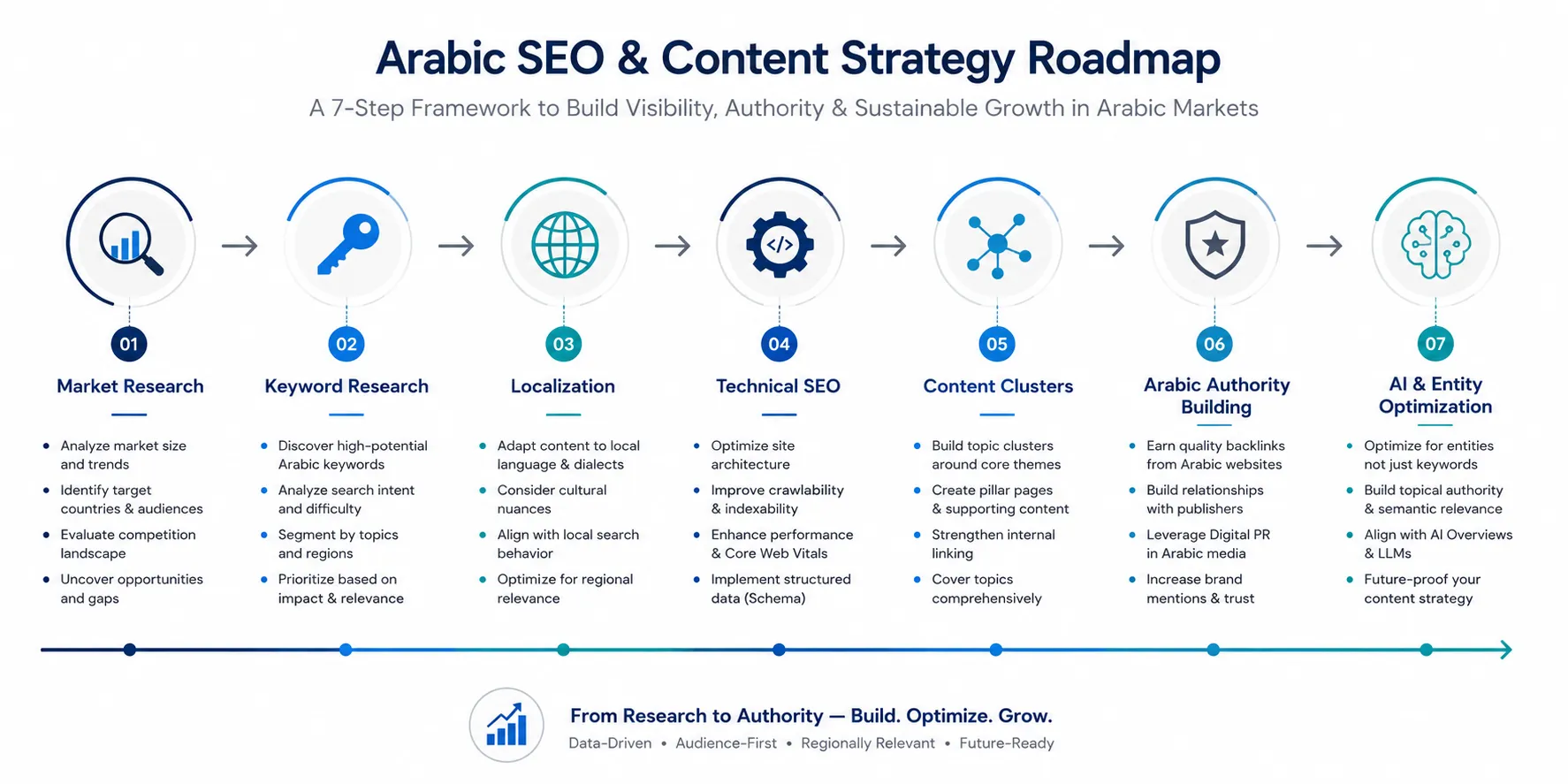
Many international SEO teams assume that Arabic SEO is simply international SEO translated into Arabic.
That assumption is one of the most expensive mistakes global brands make when entering the Middle East and North Africa (MENA).
In reality, Arabic search operates as a distinct ecosystem shaped by linguistic complexity, regional cultures, local publishers, varying levels of market maturity, and search behaviors that differ significantly from those observed in English-speaking markets.
A strategy that consistently delivers strong rankings in the United States, the United Kingdom, or Germany may underperform—or fail entirely—when applied to Arabic-speaking audiences without adaptation.
This difference extends far beyond translation. It affects nearly every layer of SEO, including:
Keyword research
Search intent modeling
Entity optimization
Content architecture
Internal linking
Digital PR
Link acquisition
Geographic targeting
User trust signals
AI-generated search experiences
As search engines increasingly rely on semantic understanding, entity relationships, and AI-powered retrieval systems, success in Arabic search depends less on translating existing assets and more on building content specifically for Arabic users, Arabic publishers, and Arabic search behavior.
This guide explains why Arabic SEO should be treated as its own strategic discipline, how it differs from conventional international SEO, and what experienced SEO teams should consider before launching campaigns across the Arabic-speaking world.
Quick Answer
Arabic SEO is fundamentally different from traditional international SEO because it requires optimization for a unique combination of language structure, regional dialects, cultural context, search intent, publisher ecosystems, and localized authority signals. Translating content alone is rarely sufficient to achieve sustainable organic visibility in Arabic search.
Arabic SEO Is Not Translation SEO
One of the most persistent misconceptions in global SEO is the belief that international expansion follows a straightforward process:
Create successful English content → Translate it → Implement hreflang → Rank.
While this workflow can produce acceptable results in some multilingual markets, it rarely performs well across Arabic-speaking regions.
The reason is simple:
Arabic users are not searching for translated English content. They are searching for information framed within their own linguistic, cultural, commercial, and regional context.
Search engines increasingly recognize this distinction.
Modern ranking systems evaluate not only lexical similarity but also semantic relevance, topical completeness, user satisfaction, and contextual authority.
A perfectly translated page may therefore satisfy linguistic accuracy while failing to satisfy actual search intent.
Consider a software company expanding into Saudi Arabia.
An English article might target:
“Best project management software”
A direct Arabic translation preserves meaning but overlooks important contextual questions such as:
Which pricing models are preferred locally?
Does the software support Arabic interfaces?
Is VAT compliance available?
Are local payment gateways supported?
Does customer support operate in Gulf time zones?
Is data hosting relevant for regional regulations?
These considerations influence user expectations and therefore influence search satisfaction.
Search engines increasingly reward content that addresses these implicit needs.
Search Engines Evaluate Context, Not Dictionaries
Google’s ranking systems have evolved from keyword matching toward understanding relationships between:
Entities
Concepts
Intent
User expectations
Context
This evolution is especially important in multilingual environments.
Two pages may express identical information linguistically while differing substantially in usefulness for local audiences.
The page demonstrating stronger contextual relevance is generally the better candidate for sustained rankings.
Practical Example
Imagine two companies entering the UAE market.
Company A
translates 150 English pages
changes navigation language
adds hreflang
publishes
Company B
Instead:
researches Arabic search behavior
rebuilds keyword targeting
rewrites content around regional questions
cites local examples
references Arabic regulations
earns links from Arabic publishers
develops Arabic topical clusters
Although both websites cover the same products, Company B builds substantially stronger topical authority within the Arabic search ecosystem.
Expert Observation
International SEO focuses on making content available in another language.
Arabic SEO focuses on making content genuinely relevant to another market.
Those objectives overlap—but they are not interchangeable.
The Arabic Search Ecosystem Is Fragmented
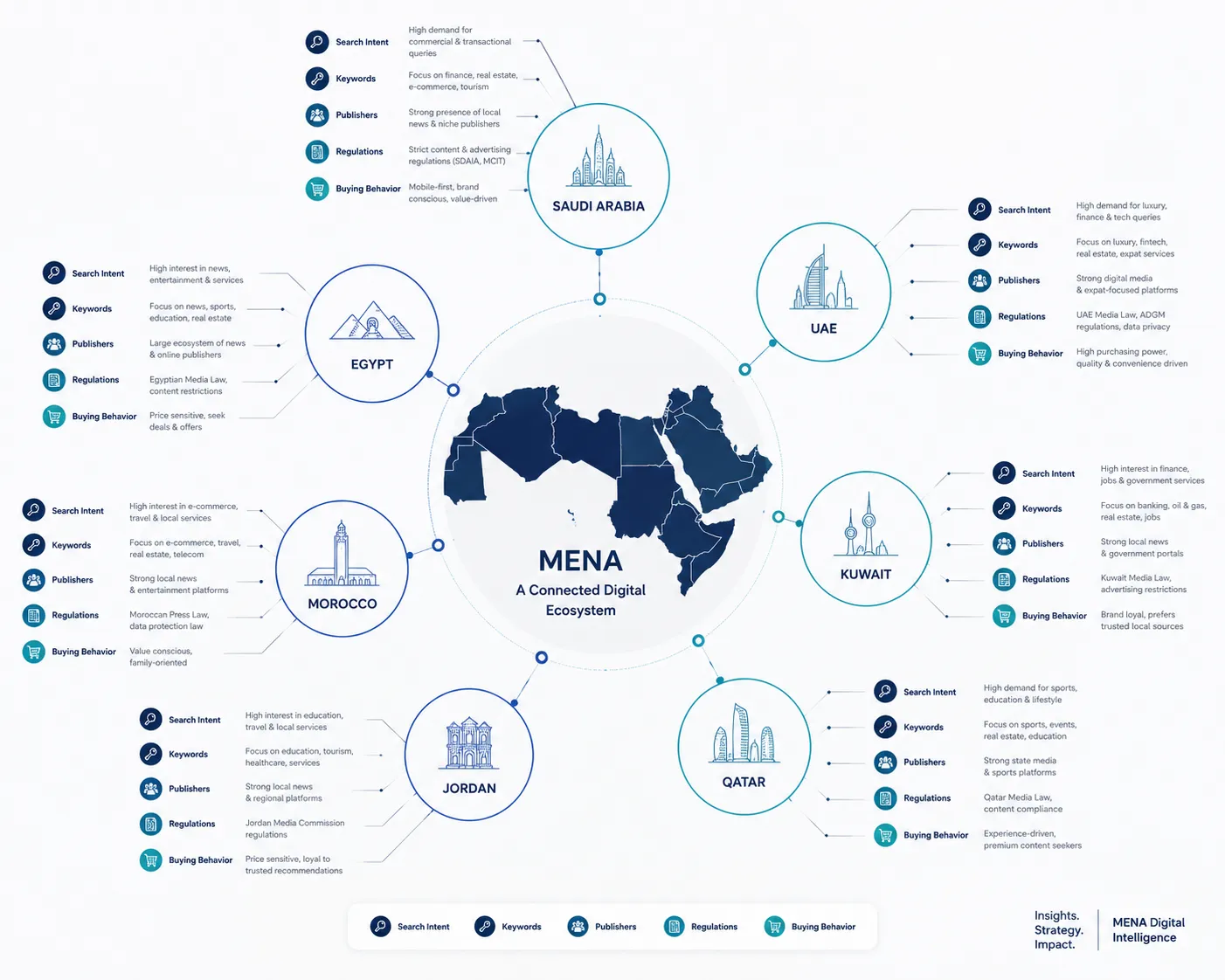
Unlike countries with relatively unified search behavior, the Arabic-speaking world consists of more than twenty countries sharing a language while differing significantly in:
economy
purchasing power
regulations
culture
terminology
technology adoption
commercial intent
Treating “Arabic” as a single market ignores substantial regional variation.
Same Language, Different Markets
A search performed in:
Saudi Arabia
Egypt
UAE
Morocco
Kuwait
may involve:
different terminology
different expectations
different brands
different purchasing behavior
different preferred websites
This variation influences ranking opportunities.
Commercial Intent Varies
Enterprise software searches in the UAE often differ from equivalent searches in Egypt.
Reasons include:
company size
digital maturity
procurement processes
payment methods
available vendors
regional regulations
Consequently, identical translated landing pages may satisfy one market while underperforming in another.
Local Authority Matters
Authority is also localized.
An internationally recognized publication may carry substantial credibility globally but have limited influence within Arabic digital ecosystems.
Conversely, respected regional publishers may exert strong topical influence despite being relatively unknown outside MENA.
For SEO campaigns involving competitive industries, regional authority often becomes an important ranking signal.
Regional Competition Differs
Competition is uneven across industries.
Some sectors have:
limited Arabic content
low topical depth
weak semantic coverage
Others—such as finance, travel, healthcare, and telecommunications—feature increasingly sophisticated Arabic publishers with extensive content ecosystems.
Understanding market maturity is therefore an important component of Arabic SEO planning.
Information Gain
Instead of asking:
“Who ranks globally?”
Arabic SEO often requires asking:
“Who owns topical authority inside this specific Arabic market?”
Those answers are frequently different.
Language Complexity Changes Keyword Research
Keyword research in Arabic introduces challenges rarely encountered in English SEO.
Many standard keyword methodologies assume relatively stable spelling, vocabulary, and syntax.
Arabic behaves differently.
Modern Standard Arabic vs Regional Dialects
Arabic users frequently alternate between:
Modern Standard Arabic (MSA)
Gulf Arabic
Egyptian Arabic
Levantine Arabic
Maghrebi Arabic
Search behavior often blends formal and conversational language.
Consequently, keyword opportunities cannot be evaluated solely through literal translations.
Multiple Valid Expressions
Users may search for the same concept using different wording.
For example:
A single product category may have several accepted names across different countries.
Each variation can represent distinct search demand.
Ignoring these variants reduces discoverability.
Singular vs Plural Behavior
Arabic morphology produces considerably more variation than English.
Search engines have become increasingly effective at understanding these relationships.
Nevertheless, content planning still benefits from recognizing:
singular forms
plural forms
definite articles
derived nouns
verb forms
particularly when building comprehensive topical clusters.
Search Intent Can Shift with Small Linguistic Changes
Minor wording differences often indicate major changes in user intent.
For example, users may seek:
information
comparisons
pricing
reviews
implementation guidance
local providers
Although the topic appears identical, each query deserves distinct content architecture.
Entity Recognition Is Increasingly Important
Traditional keyword density has limited value.
Modern search increasingly rewards strong relationships among entities including:
organizations
products
countries
industries
technologies
standards
people
Comprehensive Arabic content therefore benefits from expanding entity coverage rather than merely repeating keywords.
Expert Tip
When conducting Arabic keyword research, prioritize:
Search intent
Entity relationships
Regional terminology
Commercial context
Semantic completeness
Keyword volume alone is an insufficient decision metric.
Search Intent Is More Regional Than Most International Teams Expect
International SEO frameworks often classify search intent into four broad categories:
Informational
Navigational
Commercial
Transactional
While these categories remain useful, Arabic SEO introduces another important dimension:
Regional intent.
Two users can issue nearly identical queries while expecting entirely different answers based on their country, regulatory environment, purchasing habits, or business context.
For example, a search for enterprise payroll software may imply:
compliance with Saudi labor regulations,
UAE payroll integrations,
Egyptian tax requirements,
or support for Arabic-language HR workflows.
These expectations are rarely expressed explicitly in the query itself, yet they strongly influence which content users consider useful.
Search engines increasingly infer these contextual signals and reward pages that satisfy them.
The Difference Between Language Intent and Market Intent
A translated page may accurately answer the linguistic query while failing to address the market-specific questions users actually have.
Successful Arabic SEO therefore requires optimizing for both:
Language intent — what the words mean.
Market intent — what users actually need within their local environment.
This distinction becomes even more important in B2B sectors where purchasing decisions are influenced by regulations, local partnerships, payment infrastructure, and regional business practices.
Localization Goes Far Beyond Language
One of the biggest misconceptions in international SEO is treating localization as a post-translation task.
In mature Arabic SEO campaigns, localization is not a finishing touch—it is the foundation of the entire content strategy.
Translation changes the language.
Localization changes the experience.
The distinction has become even more important as Google and AI-powered search systems increasingly evaluate whether content genuinely satisfies users within their specific context rather than simply matching keywords.
Localization Has Multiple Layers
Many organizations think localization means:
translating interface text
converting dates
changing currencies
While these are necessary, they represent only a small portion of what search engines evaluate today.
Comprehensive Arabic localization spans several dimensions:
Layer
Traditional International SEO
Arabic SEO Best Practice
Language
Translation
Native editorial adaptation
Search Intent
Reused
Rebuilt for each market
Examples
Global
Regional
References
International
Local + international
Trust Signals
Generic
Country-specific
Commercial Context
Shared
Market-specific
Entity Coverage
Global brands
Global + regional entities
User Expectations
Standardized
Localized
Cultural Relevance Influences Content Quality
Users evaluate content through the lens of their own environment.
Examples matter.
References matter.
Case studies matter.
Even analogies matter.
Consider an article discussing ecommerce optimization.
A global article might reference:
Black Friday
Thanksgiving
Amazon Prime Day
An Arabic-focused article might instead discuss:
Ramadan commerce
Eid shopping periods
White Friday
regional marketplace ecosystems
local payment adoption
The objective is not cultural customization for its own sake.
It is reducing cognitive distance between the content and the reader’s real-world experience.
Localization Also Means Local Business Reality
Professional audiences expect answers grounded in their operating environment.
For example, B2B decision-makers may expect discussion of:
VAT compliance
regional hosting considerations
government digital initiatives
Arabic-language customer support
procurement practices
payment infrastructure
privacy regulations
Ignoring these factors often produces content that feels technically correct but commercially incomplete.
AI Systems Also Prefer Contextually Complete Content
Large Language Models increasingly retrieve passages that answer questions comprehensively.
Pages that naturally discuss:
local regulations
regional terminology
Arabic publishers
local technology ecosystems
market-specific examples
provide richer contextual signals than pages offering only translated general advice.
This improves the likelihood of being surfaced by AI-powered search experiences.
Expert Insight
Localization is no longer about adapting words.
It is about adapting knowledge.
Why Traditional International SEO Assumptions Break Down
Many enterprise SEO playbooks were developed around European languages.
These frameworks remain valuable.
However, several core assumptions become unreliable in Arabic search.
Recognizing these limitations helps prevent expensive strategic mistakes.
Assumption 1
“Translation Preserves Rankings”
It does not.
Translation preserves information.
Rankings depend on relevance.
If translated content fails to address Arabic search intent, local terminology, or regional expectations, rankings often remain limited regardless of translation quality.
Assumption 2
“Search Volume Determines Opportunity”
Search volume is only one signal.
Arabic markets often contain:
emerging demand
fragmented terminology
rapidly evolving industries
underdeveloped content ecosystems
Some of the strongest opportunities exist where search volume appears modest but competition is exceptionally weak.
Sophisticated SEO teams therefore evaluate:
topical gaps
content quality
authority distribution
intent satisfaction
publisher landscape
instead of relying solely on keyword volume.
Assumption 3
“One Arabic Version Is Enough”
Technically, one Arabic version may function.
Strategically, it often limits growth.
Markets such as:
Saudi Arabia
UAE
Egypt
can differ substantially in:
commercial vocabulary
buying behavior
regulations
examples
pricing expectations
In highly competitive industries, regional content often outperforms generalized Arabic pages.
Assumption 4
“Backlinks Behave the Same Everywhere”
Authority is contextual.
A backlink profile dominated by English publications may strengthen overall domain authority.
However, Arabic topical authority often benefits from links originating within Arabic-speaking publisher ecosystems.
These links reinforce:
language relevance
topical relationships
regional trust
market expertise
rather than simply increasing raw link metrics.
Assumption 5
“Content Depth Alone Wins”
Depth remains important.
However, comprehensive content without contextual relevance frequently loses to shorter content that better satisfies localized intent.
The winning combination is:
Comprehensive + Relevant + Localized
rather than simply
Long + Comprehensive.
Comparison
Traditional International SEO vs Arabic SEO
Traditional International SEO
Arabic SEO
Language expansion
Market expansion
Translation-first
Localization-first
Global keyword research
Regional keyword research
Generic authority
Regional authority
Universal content
Market-specific content
Shared examples
Local examples
International backlinks
Arabic publisher ecosystem
Country targeting
Country + language + culture targeting
Global entities
Regional entity network
Language optimization
Context optimization
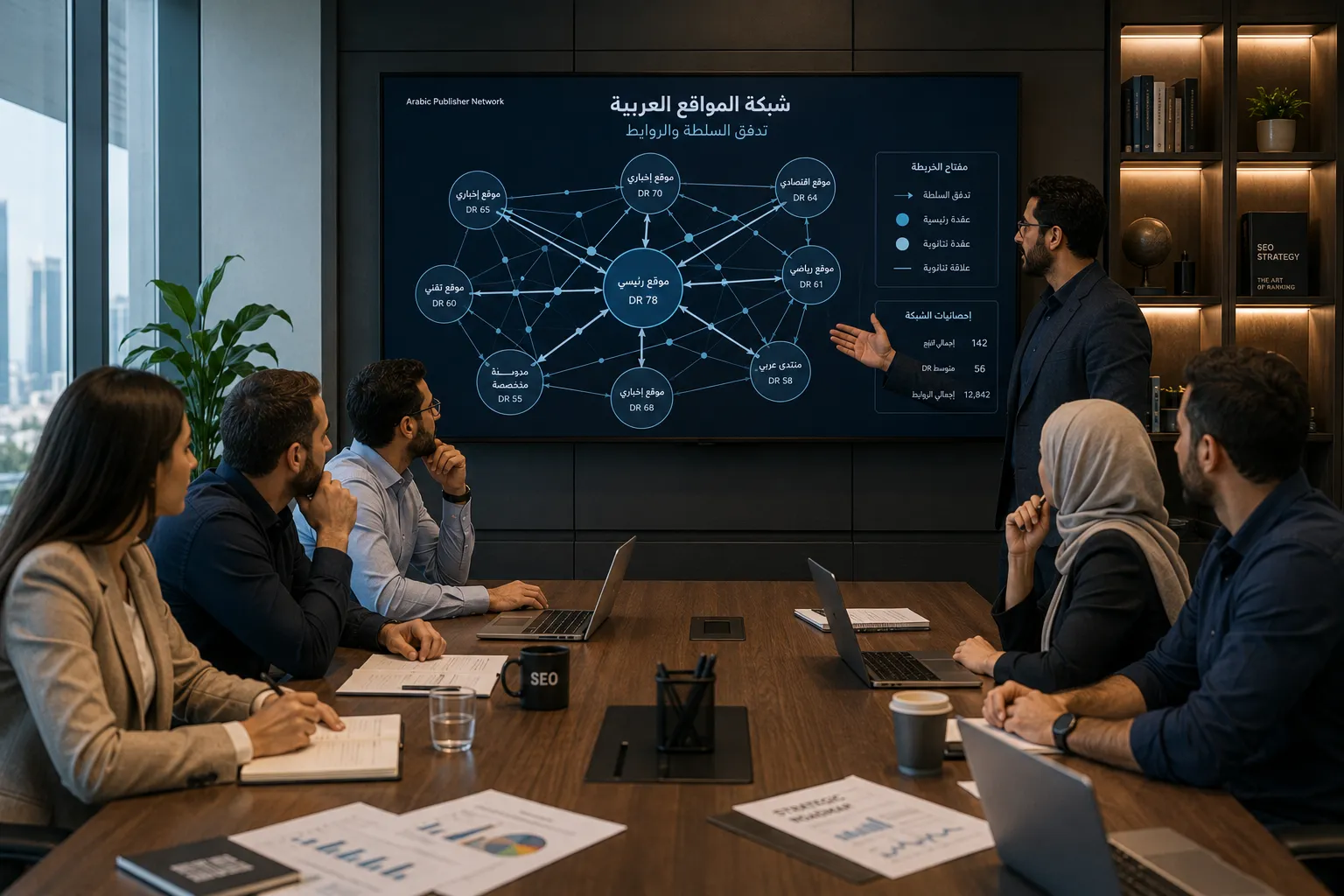
The Arabic Publisher Ecosystem Plays a Much Larger SEO Role
One of the least discussed differences between Arabic SEO and conventional international SEO is the structure of the publishing ecosystem itself.
Many international campaigns prioritize acquiring links from globally recognized domains with strong authority metrics.
While these links remain valuable, Arabic search introduces an additional consideration:
Topical authority within the Arabic web.
Authority Is Not Uniform Across Languages
Search engines evaluate websites through multiple contextual signals.
A publication may possess significant authority in English-language technology coverage while having little influence within Arabic-language discussions of the same topic.
Conversely, a respected Arabic publisher may have relatively modest international visibility yet play an important role in establishing credibility within Arabic search results.
For organizations investing in Arabic SEO, understanding this distinction influences:
digital PR strategies,
publisher outreach,
editorial partnerships,
and long-term authority building.
Relevance Often Outweighs Raw Metrics
Consider two hypothetical backlinks.
Link A
Large international publication
English article
Broad business category
Link B
Established Arabic publisher
Industry-specific article
Contextually relevant discussion
Native Arabic audience
Both links contribute value, but they strengthen different dimensions of authority.
The second often provides stronger contextual reinforcement for Arabic-language topical expertise.
Content Distribution Matters
Publishing high-quality Arabic content is only one component of visibility.
Its distribution across the Arabic publishing ecosystem influences:
discoverability,
brand familiarity,
entity recognition,
citation frequency,
and topical associations.
This becomes increasingly important as AI systems synthesize information from multiple trusted sources rather than relying on a single webpage.
Expert Observation
Many organizations underestimate how closely content strategy and digital PR intersect in Arabic SEO.
Authority is not built solely through publishing.
It is built through recognition across the broader Arabic information ecosystem.
Practical Framework
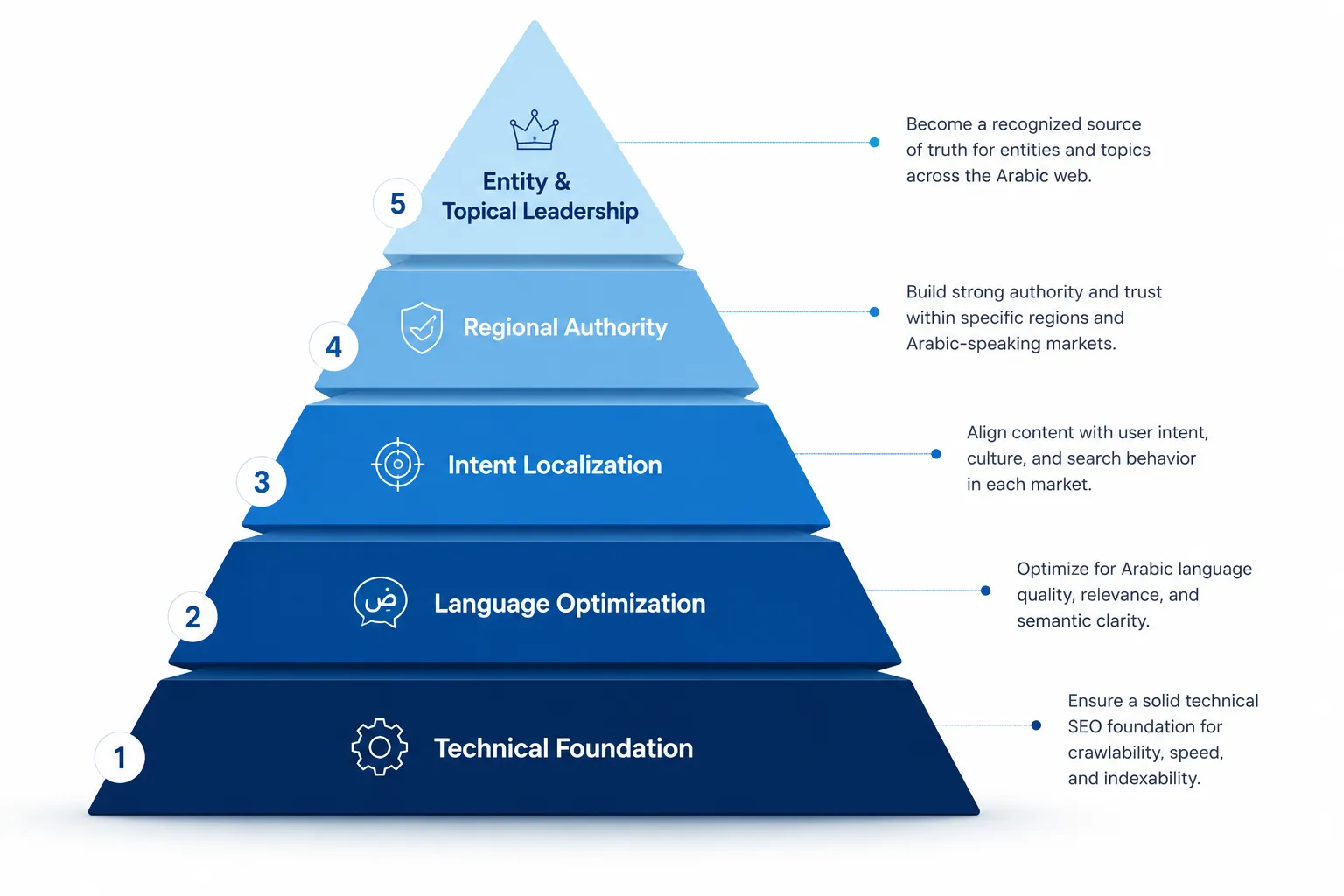
The Five Layers of Successful Arabic SEO
Instead of viewing Arabic SEO as a translation workflow, consider it as five interconnected layers.
Technical Foundation
        ↓
Language Optimization
        ↓
Intent Localization
        ↓
Regional Authority
        ↓
Entity & Topical Leadership
Each layer depends on the strength of the previous one.
Organizations that invest only in the first two layers often struggle to achieve sustained organic growth.
Decision Framework
Is Translation Enough?
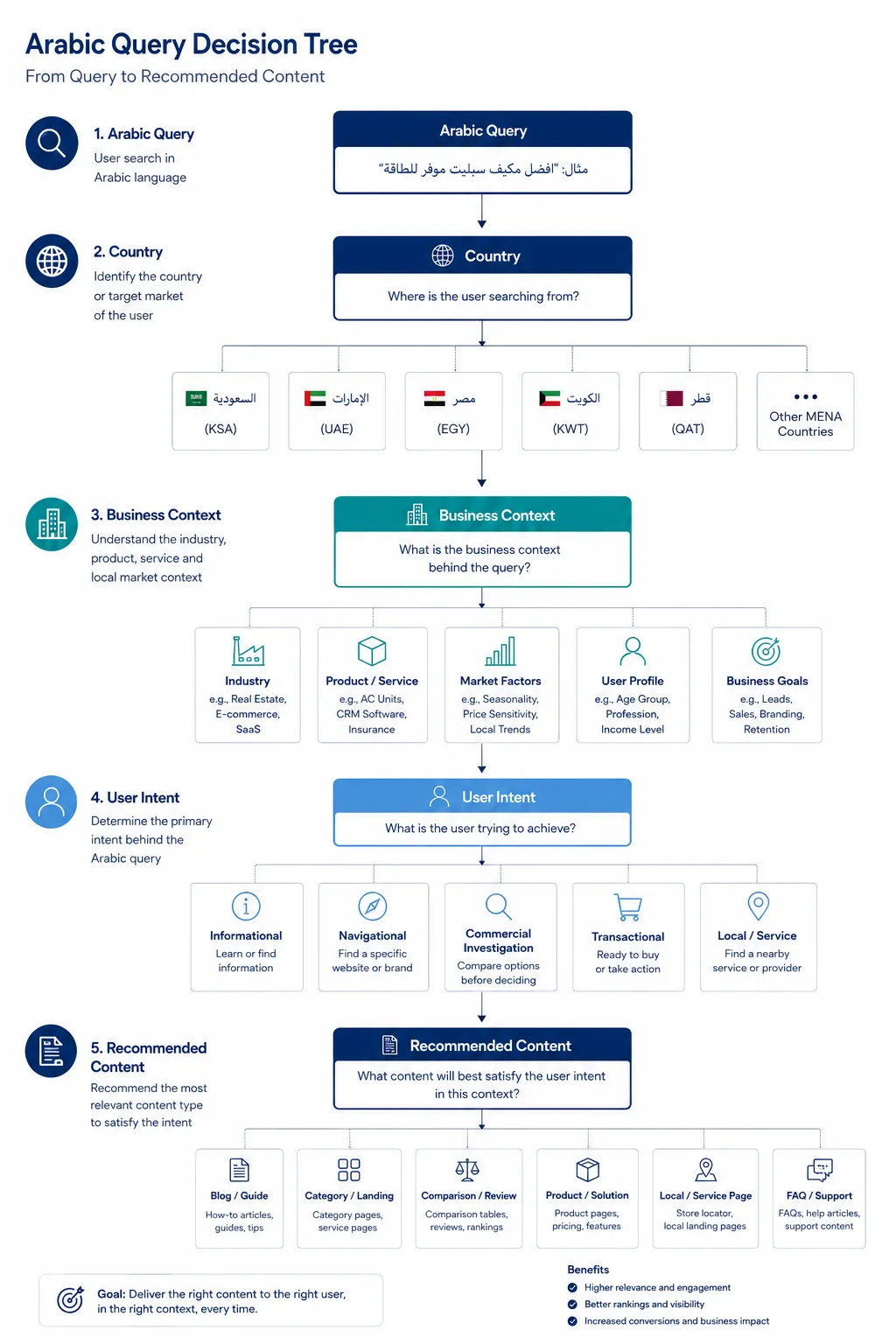
Use the following decision tree before launching Arabic content.
Is this content targeting Arabic users?

        │
        ▼

Does user intent differ by market?

        │
   Yes ─────► Rebuild content strategy
        │
        No
        ▼

Are regional examples necessary?

        │
   Yes ─────► Localize content
        │
        No
        ▼

Does the topic require local authority?

        │
   Yes ─────► Build Arabic publisher relationships
        │
        No
        ▼

Translation may be sufficient
In practice, relatively few high-value commercial topics reach the final branch without requiring additional localization.
Best Practices
Build Arabic content from search intent rather than from source-language pages.
Conduct keyword research independently for each major Arabic market where commercial priorities differ.
Incorporate regional entities, organizations, technologies, and examples naturally throughout content.
Develop topical clusters instead of isolated translated articles.
Earn editorial mentions from authoritative Arabic publications within the relevant industry.
Use native editorial review rather than relying solely on machine translation or bilingual copyediting.
Treat Arabic SEO as a long-term authority-building initiative rather than a one-time localization project.
Common Mistakes
Mistake
Why It Hurts Performance
Translating without keyword research
Misses real search demand
Using identical content across all Arabic markets
Weak regional relevance
Ignoring local publishers
Slower authority development
Measuring success only by rankings
Overlooks visibility in AI search and brand recognition
Optimizing only for keywords
Misses entities and semantic relationships
Copying English content structures exactly
Fails to address localized user expectations
Building only English backlinks
Leaves gaps in Arabic topical authority
Practical Example
Scenario
A SaaS company enters the Gulf market.
Conventional Approach
Translate website
Translate blog
Implement hreflang
Publish
Strategic Arabic SEO Approach
Research Saudi, UAE, and broader GCC search intent separately.
Identify terminology differences and commercial modifiers.
Create Arabic content clusters around localized business problems.
Reference regional regulations, payment systems, and implementation considerations where relevant.
Build relationships with credible Arabic industry publications.
Measure success using organic visibility, qualified traffic, branded search growth, entity recognition, and citations in AI-driven search.
The second approach typically requires more initial investment but creates a stronger foundation for sustainable organic growth and market credibility.
Measuring Success in Arabic SEO Requires Different KPIs
Many international SEO teams evaluate campaign performance using a familiar set of metrics:
Organic traffic
Keyword rankings
Click-through rate (CTR)
Conversions
Referring domains
These metrics remain important, but by themselves they often fail to capture whether an organization is actually becoming an authority within the Arabic search ecosystem.
A mature Arabic SEO strategy should measure both visibility and market authority.
An optimized Arabic website can become the authoritative reference within its niche.
Those are fundamentally different business outcomes.
Arabic SEO in the Age of AI Search
The transition from keyword-based retrieval to AI-assisted search has amplified many of the characteristics that already distinguished Arabic SEO from conventional international SEO.
Large Language Models increasingly retrieve information based on:
semantic completeness
contextual relevance
entity relationships
factual consistency
topical authority
rather than exact keyword matching.
For Arabic SEO, this creates both opportunities and challenges.
AI Systems Reward Complete Context
AI assistants prefer content that answers not only the primary question but also the surrounding questions users are likely to ask next.
For example, an article about Arabic SEO should naturally explain:
localization
regional search behavior
entity optimization
publisher authority
link acquisition
dialect considerations
multilingual architecture
AI search implications
This interconnected structure makes content easier for AI systems to summarize and cite.
Entity Relationships Become More Valuable
Modern retrieval increasingly depends on how clearly content connects relevant entities.
For this topic, important entities include:
Google Search
Google Search Central
Google AI Overviews
Bing
Bing Copilot
hreflang
MENA
GCC
Modern Standard Arabic
Arabic publishers
Digital PR
Entity SEO
Semantic SEO
Strong entity relationships improve both traditional search understanding and AI retrieval.
Information Gain Matters More Than Ever
AI systems have already seen thousands of articles explaining the basics of international SEO.
They are more likely to surface resources that contribute genuinely new perspectives.
For this topic, examples of information gain include:
explaining regional intent,
comparing Arabic publisher ecosystems,
introducing authority frameworks,
discussing entity localization,
examining AI retrieval implications.
Rather than repeating common advice, successful Arabic SEO content expands the available knowledge graph around the subject.
Expert Tips
1. Build Topic Clusters, Not Individual Articles
Individual rankings fluctuate.
Topical authority compounds.
Develop interconnected resources covering:
Arabic keyword research
Arabic technical SEO
Arabic content localization
Arabic Digital PR
Arabic link building
Arabic entity SEO
Arabic AI search optimization
Together, these resources reinforce one another.
2. Optimize for Questions, Not Just Keywords
Professional audiences increasingly search using problem-oriented queries such as:
Why isn’t translated content ranking?
How does Arabic keyword intent differ?
Should GCC countries share the same landing pages?
How do Arabic backlinks influence authority?
Answering these questions strengthens both search visibility and AI retrieval.
3. Treat Publishers as Authority Partners
Digital PR should support SEO—not operate independently.
Editorial mentions across reputable Arabic publications strengthen:
entity recognition,
trust,
topical associations,
and long-term authority.
4. Invest in Native Editorial Expertise
Native editing improves more than grammar.
It improves:
terminology,
examples,
nuance,
credibility,
and search intent alignment.
Implementation Checklist
Use this checklist before launching an Arabic SEO initiative.
Strategy
Define target Arabic markets individually.
Identify commercial priorities by country.
Map user journeys.
Audit existing content for localization gaps.
Keyword Research
Conduct Arabic-first keyword research.
Validate regional terminology.
Identify semantic clusters.
Map keywords by intent.
Content
Create native Arabic content where possible.
Localize examples and references.
Build topic clusters.
Expand entity coverage naturally.
Technical SEO
Implement correct hreflang.
Review language targeting.
Optimize Core Web Vitals.
Validate structured data.
Authority Building
Earn links from relevant Arabic publishers.
Invest in Digital PR.
Strengthen brand mentions.
Monitor entity recognition.
AI Readiness
Write concise definitions.
Structure content with descriptive headings.
Use comparison tables.
Include practical frameworks.
Answer related questions comprehensively.
Key Takeaways
Arabic SEO is a distinct strategic discipline—not a translation project.
Search intent varies significantly across Arabic-speaking markets.
Localization should address language, culture, business context, and user expectations.
Regional topical authority is built through high-quality Arabic content and trusted Arabic publisher ecosystems.
Entity optimization and semantic completeness are increasingly important for both traditional search and AI-powered retrieval.
Success depends on becoming contextually authoritative within the Arabic search ecosystem rather than simply making content available in Arabic.
Conclusion
Organizations entering Arabic-speaking markets often begin with a translation initiative because it appears to be the fastest path to international expansion. However, sustainable organic growth requires a different mindset.
Arabic SEO is best viewed as a specialized discipline at the intersection of language, regional market knowledge, semantic optimization, technical SEO, and authority building.
The most successful organizations do not ask, “How do we translate our SEO strategy?” Instead, they ask, “How do Arabic users search, evaluate information, and make decisions?”
That shift—from language adaptation to market understanding—is what separates websites that merely exist in Arabic from those that become trusted resources across the MENA region.
As AI-powered search continues to prioritize contextual relevance, semantic relationships, and authoritative sources, this distinction will only become more important.
Frequently Asked Questions
Is Arabic SEO just international SEO in Arabic?
No. Arabic SEO requires dedicated keyword research, localization, regional intent analysis, and authority building. Translation alone rarely delivers competitive results.
Can one Arabic website effectively target every Arabic-speaking country?
It depends on the industry and competition level. A shared Arabic site may be sufficient for some informational topics, but commercial sectors often benefit from country-specific optimization and localized content.
Why do translated pages often fail to rank?
Because search engines evaluate relevance, user satisfaction, and contextual completeness—not linguistic accuracy alone.
Do Arabic backlinks matter?
Yes. Relevant links from authoritative Arabic-language publishers help strengthen topical and regional authority, complementing high-quality international backlinks.
Is Modern Standard Arabic enough?
Modern Standard Arabic should usually form the foundation of content, but keyword research should account for regional terminology and search behavior across target markets.
How does AI search affect Arabic SEO?
AI systems increasingly favor content with strong entity relationships, clear structure, comprehensive topic coverage, and contextual relevance. These characteristics align closely with best practices for modern Arabic SEO.
Final Summary
Arabic SEO is not a regional variation of international SEO—it is a specialized discipline with its own linguistic, cultural, technical, and authority-building requirements. Organizations that rely solely on translation typically underperform because they optimize for language rather than context. Sustainable success comes from combining localized search intent, native-quality content, regional entity optimization, trusted Arabic publisher relationships, and technically sound multilingual implementation. As search continues to evolve toward AI-driven retrieval, these principles become even more critical, making Arabic SEO a strategic investment in long-term market authority rather than a simple localization exercise.
How do you verify the quality and metrics of your Arabic publishers?
We continuously audit publishers using Ahrefs metrics (DR, organic traffic), index stability, and spam scores to guarantee authentic, high-value media placements.
Are article placements permanent and guaranteed to be indexed?
Yes, all sponsored articles and Digital PR placements are non-removable and come with a 100% Google indexation guarantee or full refund.
What is the average turnaround time (TAT) for publishing?
Standard publication turnaround time ranges between 3 to 7 business days depending on the selected media outlet and editorial review.
Can PublishBridge handle Arabic content creation and localization?
Absolutely. Our in-house editorial team creates tailored, high-converting Arabic press releases and articles optimized for regional search intent.
Do you offer custom agency discounts or bulk pricing?
Yes, we provide volume-based discounts and custom invoicing solutions for SEO agencies managing multiple client accounts.
Stay Ahead in Arabic Digital PR
Subscribe to receive exclusive insights on MENA search trends, new verified publisher additions, and agency strategies.
Need a Custom Media Strategy?
Schedule a brief consultation with our Arabic Digital PR specialists to discuss your campaign targets and custom bulk pricing.